
An industry perspective from Giardina Atelier
For many first-time fashion founders, the greatest fear surrounding a collection is production. Questions about factories, minimum order quantities, manufacturing delays, quality control, and logistics tend to dominate early conversations. It is understandable. Production appears to be the moment where everything is at stake, where a single mistake could multiply across dozens or hundreds of garments.
Yet after nearly a decade of developing luxury collections, we have found that this assumption is perhaps the biggest misconception in fashion.
Production is not the most difficult stage of building a successful collection. Development is.
In fact, when development has been approached correctly, production often becomes one of the simplest and most predictable phases of the entire process. The opposite is equally true. When development is rushed, underestimated, or built on weak technical foundations, production simply magnifies those problems on a much larger scale.
Understanding this distinction fundamentally changes the way successful brands allocate their time, budget, and expectations.
Development Is the Engineering Phase of Fashion
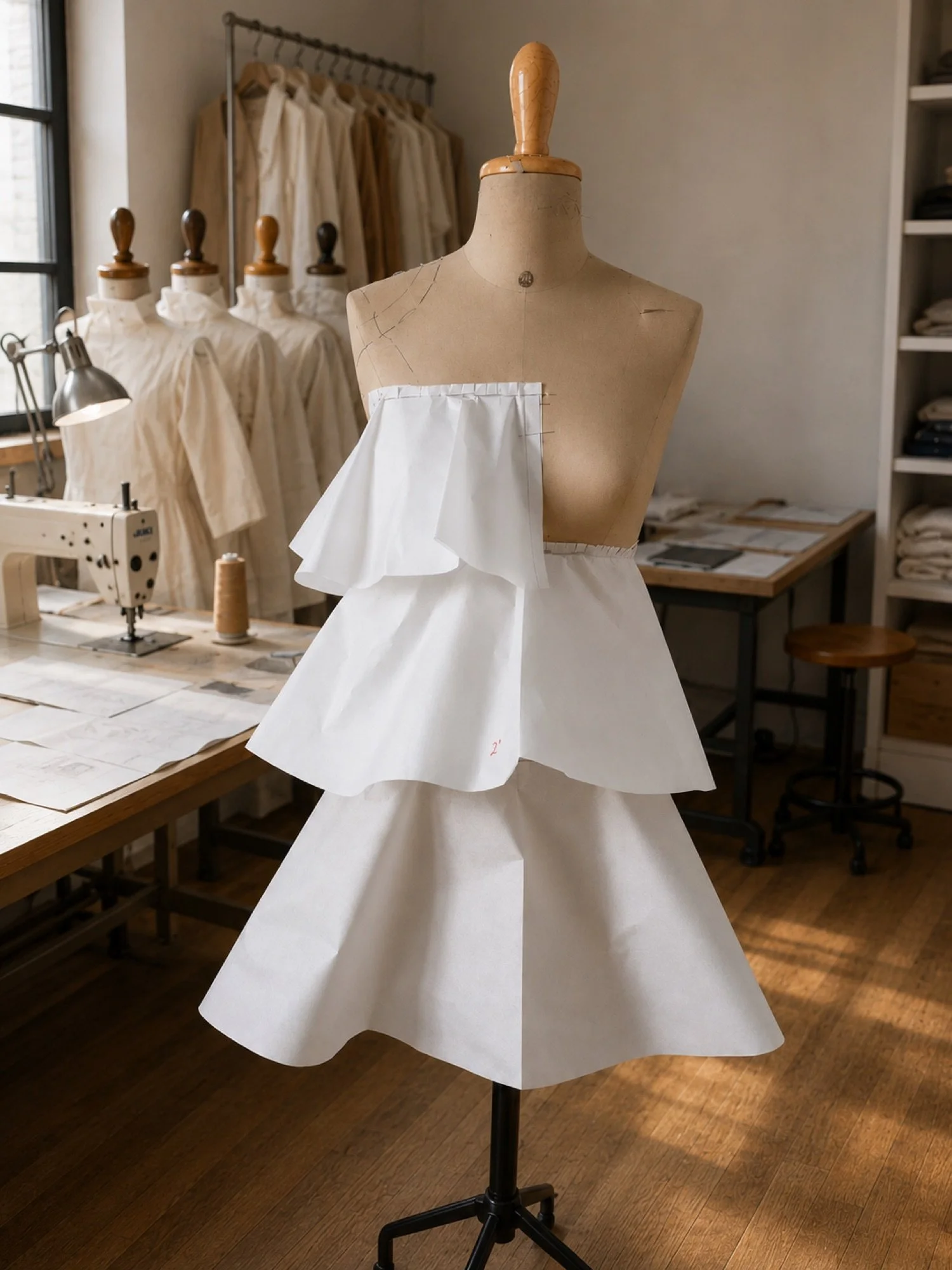
The word development is often misunderstood. Many imagine it simply means creating one sample before moving into production. In reality, development is the engineering phase of fashion. It is the moment where an idea leaves the imagination and begins its transformation into a functional object that must fit a human body, perform consistently in fabric, and ultimately withstand manufacturing at scale.
Unlike production, development has no roadmap. Every new design begins as something that has never existed before.
No one has ever made that exact silhouette with those exact proportions, in that precise fabric, using those particular construction techniques and details. The first sample is not a reproduction of an existing garment—it is the birth of an entirely new one.
That distinction is incredibly important because it explains why development naturally involves exploration, refinement, and adjustment. Fashion is not merely an artistic discipline; it is also an engineering discipline. A sketch may beautifully communicate an idea, but translating that two-dimensional drawing into a three-dimensional garment that hangs correctly, balances on the body, supports movement, and delivers the designer's vision requires an extraordinary amount of technical interpretation.
This is where experienced patternmakers become invaluable.
Their role extends far beyond drafting lines on paper. They are responsible for translating proportion, balance, movement, ease, construction, and fit into a technical language that fabric can understand. Even with decades of experience, there are aspects of a garment that simply cannot be perfected until they exist physically.
A Prototype Is a Conversation Between Creativity and Engineering
This brings us to another misconception we encounter almost daily.
Many emerging brands approach prototyping with expectations shaped by the convenience of modern consumer culture. We live in a world where almost everything can be purchased with a single click and delivered within days. It is only natural that this mindset quietly influences expectations around product development.
Luxury fashion, however, does not operate this way.
A prototype is not a finished product. It is a conversation between creativity and engineering.
Its purpose is to answer questions that no drawing, rendering, or technical package can answer completely. Perhaps the shoulder requires another centimeter of balance. Perhaps the neckline opens differently once it is cut in silk rather than illustrated on paper. Perhaps a dart needs to rotate, a seam requires reshaping, or a particular fabric behaves differently than originally anticipated.
These discoveries are not signs that something has gone wrong.
They are precisely the reason prototypes exist.
Every fitting teaches us something new about the garment. Every revision moves the design closer to the version the designer imagined from the beginning. The prototype is not evidence of failure; it is evidence that development is working exactly as it should.
At Giardina Atelier, we often reassure clients that revisions should never be feared. Some refinement is not only expected—it is essential. Every couture house in the world refines its garments before approving them for production. Perfection is rarely created in a single iteration because true luxury is achieved through careful observation, thoughtful adjustment, and technical precision.
The Difference Between Healthy Refinement and Technical Inefficiency
There is, however, an important distinction between healthy refinement and technical inefficiency.
A pattern that requires small adjustments after its first fitting is entirely normal. A pattern that must be rebuilt repeatedly because the bust never fits correctly, the balance remains unstable, or the construction continues to fail is something entirely different.
Those situations rarely indicate that development itself is flawed.
More often, they reveal weaknesses in the technical foundation upon which the garment was built.
Over the years, we have reconstructed countless patterns created elsewhere that arrived with persistent fitting problems, distorted proportions, and structural inconsistencies. Once those technical foundations were rebuilt correctly, development accelerated dramatically because the underlying engineering finally supported the design instead of working against it.
Factories Do Not Create Successful Products — They Reproduce Them
This is precisely why our philosophy has always centered around technical development before anything else.
Factories do not create successful products.
Factories reproduce successful products.
If a garment enters production with unresolved fit issues, inaccurate patterns, or incomplete technical information, manufacturing will simply repeat those mistakes over and over again. Production is extraordinarily efficient at multiplying whatever technical foundation it receives.
When that foundation is strong, production becomes remarkably straightforward.
Industry-standard manufacturing timelines often range between six and eight weeks depending on complexity and volume. Contrary to popular belief, production itself is rarely where brands lose the most time. Delays almost always originate much earlier, during development, where technical questions remain unresolved long after manufacturing should have begun.
Arrive at Production With Every Decision Already Made
For this reason, we encourage every emerging designer to rethink where they invest their greatest attention.
The goal should never be to reach production as quickly as possible.
The goal should be to arrive at production with complete confidence that every technical decision has already been made.
When your pattern has been perfected, your fit approved, your construction engineered, your materials validated, and your sample refined through careful development, production ceases to feel intimidating. It simply becomes the disciplined repetition of work that has already been perfected.
Perhaps that is the greatest lesson fashion teaches us.
The beauty customers admire on the outside is almost always the result of invisible technical decisions made long before the first garment ever entered production.
Luxury is not created on the production line.
It is created during development.
Everything that follows is simply the faithful execution of that foundation.
About Giardina Atelier
Giardina Atelier is an Italian luxury fashion atelier specializing in Made in Italy garment development, luxury fashion tech packs, couture patternmaking, prototype and sample development, and small-batch luxury clothing production.
Working with emerging and established premium brands worldwide, Giardina Atelier combines heritage Italian craftsmanship with meticulous technical documentation to transform creative concepts into production-ready collections.
From the first technical foundation to final luxury garment development, our atelier supports brands through a clear, structured, and highly considered fashion product development process designed to protect quality, preserve craftsmanship, and bring exceptional garments to life. If you are building your own, start with a brief.