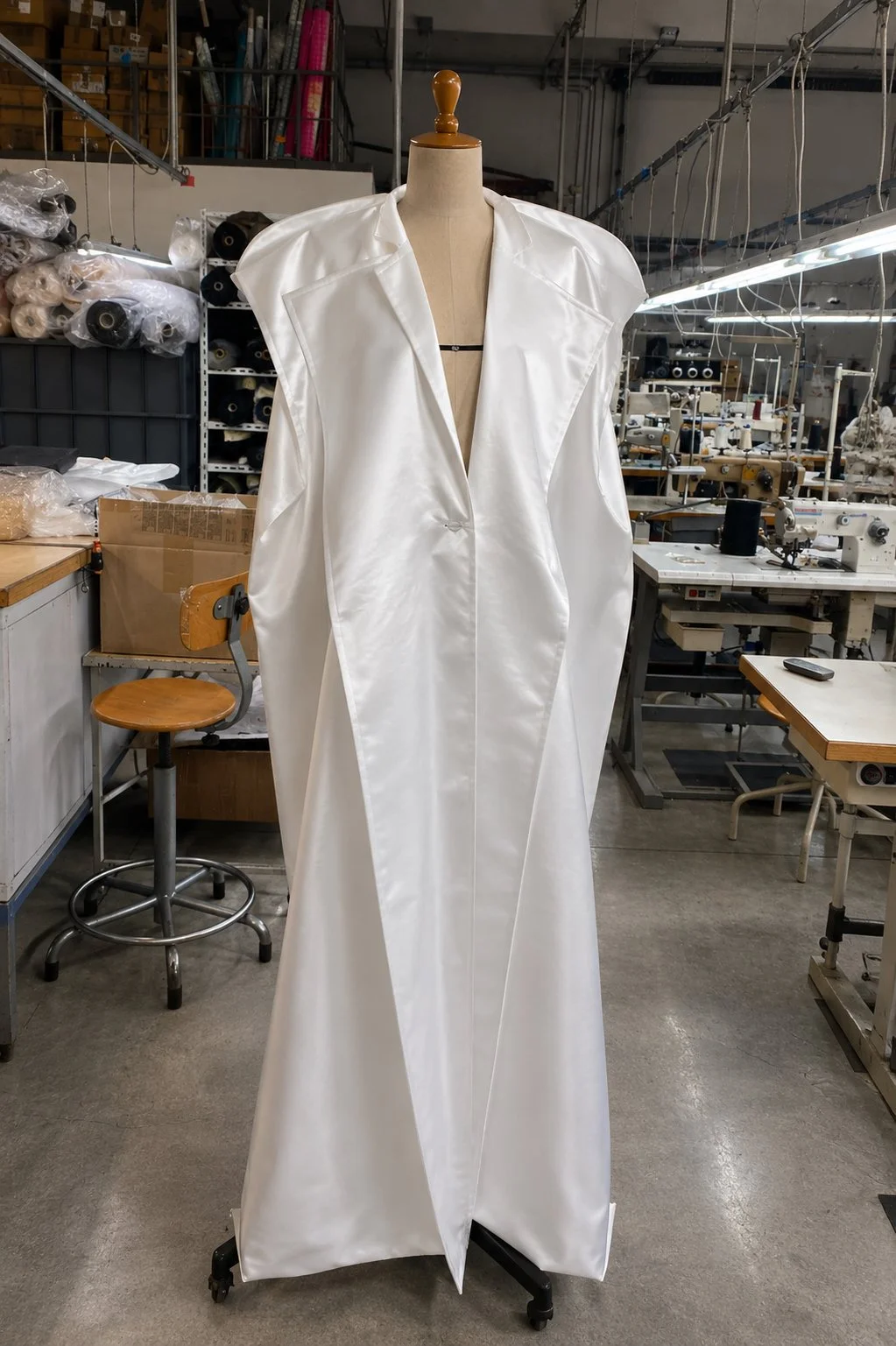
There is a particular romance attached to making clothes in Italy. Made in Italy evokes beautiful fabrics unfurling across cutting tables, patterns drawn by practiced hands, softly humming machines, meticulous fittings, and garments passing between artisans who understand instinctively that a millimeter can change everything. For an emerging designer, it is an intoxicating world: the moment when something imagined privately begins, finally, to become real.
What is rather less romantic, but infinitely more important, is understanding who pays for all of it.
One of the most common mistakes we see among startup fashion brands is also one of the most fundamental: misunderstanding the minimum order quantity, or MOQ. A founder approaches an Italian fashion atelier wanting ten jackets, perhaps fifteen dresses, and is surprised when the manufacturer explains that production begins at a higher quantity. Why should I order 50 when I only need 16? Why can't I test the market first? Why is the atelier asking me to manufacture more than I want?
The answer is surprisingly simple. The atelier is not trying to sell you more. It is trying not to lose money making less.
The Atelier Is Not Trying to Sell You More
An MOQ is not an exercise in greed, nor is it a mechanism designed to strong-arm emerging designers into unnecessary inventory. It is the economic threshold at which making your product becomes commercially viable for the business making it. Before a single finished garment exists, costs have already begun accumulating. A pattern maker has worked on the pattern. A cutter has prepared the cloth. A sample maker has constructed the prototype. Machines have been prepared and maintained. Production has been scheduled. Seamstresses, technicians and production managers have allocated their time to your project. There is rent, electricity, equipment, administration and quality control. Someone, quite literally, has to keep the lights on.
The same reality exists throughout the Italian fashion supply chain. A textile artisan creating a special fabric or custom color has setup costs before the first meter is produced. A button maker developing something bespoke has machinery, materials and labor to consider. The same applies to labels, embroidery, trims and hardware. Whether you are working with a luxury clothing manufacturer in Italy or one of the specialist artisans surrounding it, making something specifically for your brand requires another business to activate its people, materials, machinery and time.
The MOQ is simply the mathematical expression of that reality.
There is, of course, nothing wrong with wanting to minimize risk. For a startup fashion brand, capital is precious and inventory can represent an enormous financial commitment. Testing demand before scaling production can be intelligent business. But there is an important distinction between reducing your own risk and transferring that risk to somebody else.
Suppose the minimum for your style works out to around 50 units, but you would like to manufacture 16. You may quite reasonably think, I don't know whether I can sell 50. I would rather manufacture 16, see what happens and order more if they sell.
Minimums are set per style and confirmed case by case — often from around twenty units, and higher for more complex construction. The current terms are in Before you order.
The difficulty is that the atelier's startup costs do not disappear because you would prefer a smaller order. The pattern still has to be prepared. Fabric still has to be cut and placed. Machines and people still have to be allocated. Production still needs to be managed. Quality still has to be controlled. A place in the atelier's calendar still has to be reserved.
If the smaller quantity cannot economically support those costs, asking for 16 pieces at standard production pricing is effectively asking the manufacturer to absorb part of the financial risk of testing your product.
Your Manufacturer Is Not Your Investor
And this is where emerging brands need to understand an essential distinction: your manufacturer is not your investor.
Your atelier may become an extraordinary creative and technical partner. Its team may care deeply about your collection and contribute expertise that transforms it. But the atelier is still an independent business you have hired to make your product. The same is true of your textile producer, pattern maker, button artisan and trim manufacturer. They are not there to finance the uncertainty of launching your company.
There is a peculiar contradiction in saying, in effect, I am not yet prepared to invest this amount in my own brand because I don't know whether it will work, but I would like you to invest your time and money so that I can find out.
If the founder is unwilling to assume the financial risk of the brand, why should the people manufacturing it be expected to assume that risk instead?
Small Batch Is Not the Same as Any Quantity You Like
This is especially important for designers searching for a small-batch clothing manufacturer in Italy. Small-batch Made in Italy production absolutely exists. But somewhere along the way, small batch has become confused with any quantity I would like, and they are not the same thing.
Imagine a collection of four styles, each manufactured in quantities of ten, fifteen or perhaps twenty pieces. Those are very small quantities per style, yet together they form a meaningful production order. The atelier can distribute its startup costs and production capacity across the collection.
Now imagine that the brand eliminates three of those four styles and decides to manufacture only sixteen pieces of the remaining design. The quantity per style may still sound like the micro-production originally discussed, but commercially, the project has changed entirely. The atelier's startup costs have not disappeared because the collection became smaller.
The brand changed its commitment. The manufacturer may therefore have to change its production terms.
That is not necessarily a reversal of what was previously discussed. It is arithmetic.
When Development Must Become Production
The same principle applies when development itself continues to evolve. Perhaps the first sample has been completed, but now the outer fabric is changing. The lining is different. There is a new button. The fit requires another adjustment. The pattern must be updated. Naturally, the founder would like another pre-production sample in the final materials before committing to production.
From the brand's perspective, these can appear to be small refinements on the road to perfection. From the atelier's perspective, they are hours. Another pattern intervention. Another sample. Another fitting. Another technical review. Another allocation of development capacity.
Luxury fashion development is not an endless subscription to an atelier's expertise. At some point, development must become production.
The Best Ateliers Have Choices
This brings us to another reality rarely discussed when emerging designers search for the perfect Made in Italy clothing manufacturer: the best ateliers have choices.
An exceptional pattern maker can develop only so many patterns in a month. A talented sample maker has only so many working hours. A cutting table cannot hold every collection simultaneously. Skilled seamstresses are finite. Production calendars are finite. Every development or manufacturing slot allocated to one brand is capacity that cannot be allocated to another.
A serious Italian fashion atelier is therefore evaluating a young brand just as surely as the young brand is evaluating the atelier. The founder is asking, Can these people make my vision? The atelier must ask something equally important: Does it make commercial sense for us to devote our people and capacity to this project?
This is why finding an excellent manufacturer should change the way a founder thinks.
Emerging designers can spend months searching for a luxury clothing manufacturer in Italy capable of beautiful Made in Italy production, sophisticated patternmaking, exceptional sample development, thoughtful construction and access to extraordinary Italian textiles and craftsmanship. Then, finally, they find one. The sample arrives and it is phenomenal. The proportions are right. The fit works. The stitching is impeccable. The garment finally resembles the thing that existed in the designer's imagination.
And the first question becomes: How little can I order?
Perhaps the more sophisticated question is: What commitment makes my brand a client this atelier wants to keep?
Because the best manufacturing relationships are reciprocal. Your atelier should respect your capital, your deadlines and your creative vision. You should respect its expertise, its production calendar, its startup costs and the value of its time. Neither business should be expected to build the other's at its own expense.
Fashion loves the word partnership, and rightly so. A remarkable manufacturing relationship can become one of the greatest competitive advantages a luxury fashion brand possesses. But partnership cannot become another word for subsidy.
A mutually beneficial fashion manufacturing relationship means the brand receives craftsmanship, technical expertise, pattern development, sampling, production and quality control at the level its product requires. The atelier receives enough business to pay its specialists, cover its operating costs, maintain its standards and justify dedicating finite capacity to the brand.
That is not greed. That is what allows craftsmanship to remain a viable business.
At Giardina Atelier in Rome, where luxury fashion development and Made in Italy production are informed by the disciplines of Italian Alta Moda/Couture and luxury ready-to-wear, the relationship between creativity and commercial reality is inseparable. A beautiful garment does not emerge from an abstract concept called "production." It passes through the hands of pattern makers, sample makers, cutters, seamstresses and specialist Italian artisans. It requires judgment, technique, infrastructure and time.
These are not incidental costs surrounding the garment. They are the reason the garment exists.
What to Ask Before Production Begins
For startup and emerging designers considering fashion development and production in Italy, the MOQ conversation should therefore happen early. Ask whether the minimum applies per style, per color, per fabric or across the collection. Understand how the number of styles affects the overall production volume. Ask what quantity qualifies for standard production pricing and how extremely small runs are priced. Understand the distinction between sample pricing and production pricing. And if the scope of your collection changes during development, understand that the economics of manufacturing it may change as well.
Most importantly, build those realities into your business plan before production begins.
There is nothing unsophisticated about starting small. Some extraordinary fashion businesses began with very little. But there is an enormous difference between starting small and expecting another business to finance the economics of your smallness.
An MOQ is often simply the boundary between the two.
Your Italian atelier has a business to protect. Your textile artisans have businesses to protect. Your pattern makers have livelihoods. Your production team has salaries. The people bringing your vision into physical existence deserve the same commercial consideration you expect for your own brand.
So, startup brands, be wise. When you finally find an Italian fashion atelier capable of making what you imagined, beautifully and at the standard your name deserves, do not spend all of your energy asking how little you can commit.
Build a relationship worth keeping.
Because a great atelier can refine your product, elevate your collection and transform an idea into something worthy of the words Made in Italy. But it cannot believe in your business financially on your behalf.
At some point, the investment has to begin with you.