
The logo may introduce your brand. The campaign may make people desire it. But the product is what determines whether they come back.
In the race to launch a fashion brand, it is remarkably easy to become consumed by everything surrounding the product. The name. The logo. The packaging. The e-commerce site. The campaign. The runway show. The launch date. The social strategy. All of these elements matter, particularly in the luxury market, where image and storytelling are inseparable from perception. But none of them can compensate for a product that was rushed into existence.
At Giardina Atelier, an Italian luxury fashion development atelier near Rome, we believe one of the most important—and most underestimated—parts of building a luxury fashion brand is simply giving the product enough time to become exceptional.
Your Product Is Your Brand
A beautiful identity can attract a customer once. A beautiful product is what begins to build a reputation.
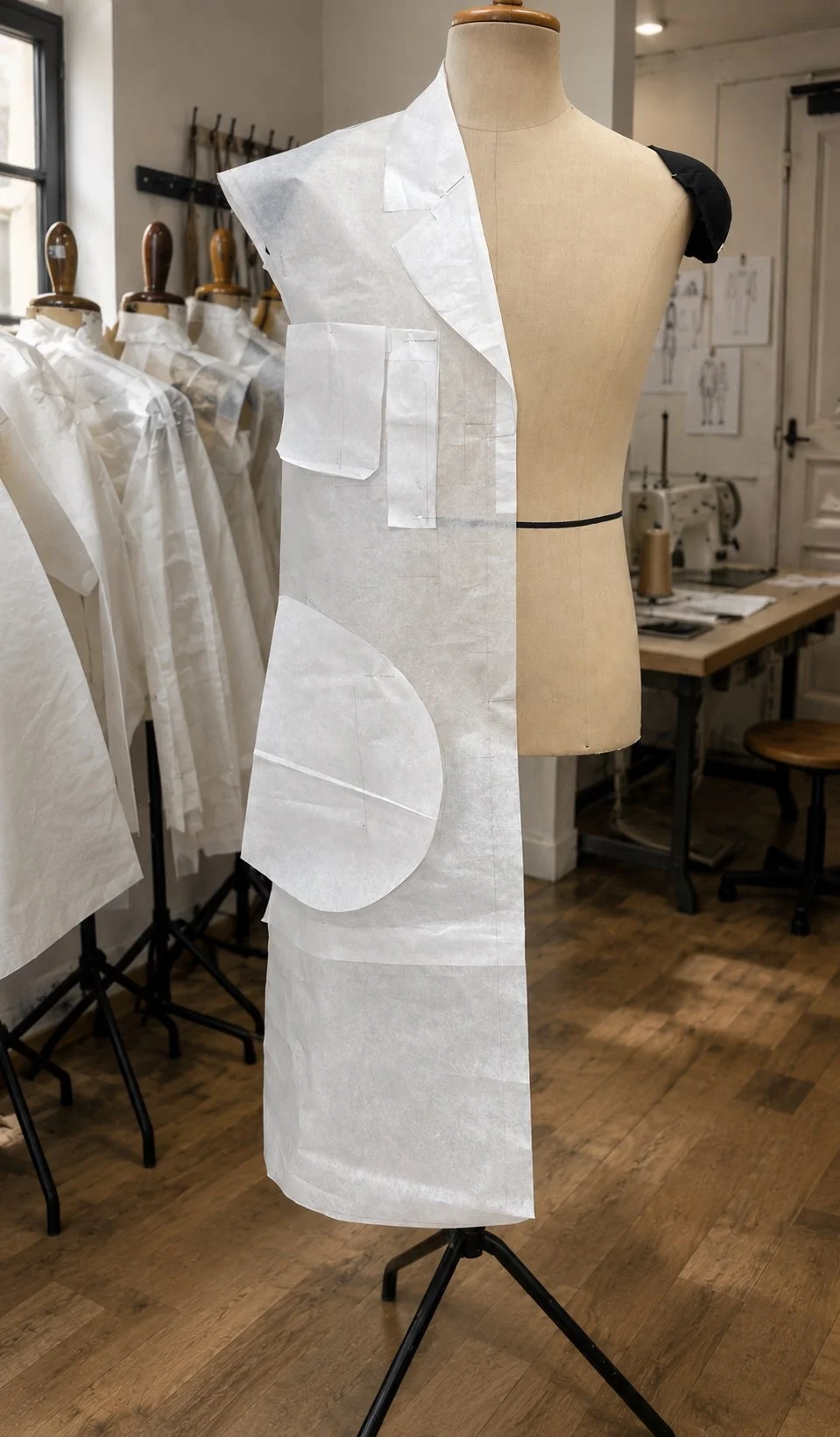
Before a garment can be photographed, marketed, shown, sold, or produced, it has to be developed. That means translating an idea from a sketch into an intelligently engineered three-dimensional object through Made in Italy tech pack development, couture pattern making, fabric sourcing, prototype development, sample making, fittings, corrections, construction refinement, and production preparation.
This is where the real product is created.
For emerging designers and established luxury fashion brands alike, development should therefore not be treated as the inconvenient period between design and launch. Fashion product development is the foundation upon which the launch depends.
Without enough development time, compromises inevitably begin to appear. A silhouette may not fall exactly as intended. A seam may need repositioning. The internal construction may need greater support. A beautiful fabric may behave completely differently once cut into the garment. A proportion that looked perfect on paper may feel entirely different when seen on the body.
These are not necessarily signs that something has gone wrong. They are signs that product development is doing its job.
The First Fashion Sample Is Not Supposed to Be Magic
There is a persistent misconception among new fashion brands that the first prototype should emerge perfectly finished, exactly as imagined.
In reality, luxury fashion sample development is an iterative process.
The first sample creates information. It allows the designer, couture patternmaker, and samplemaker to see the garment in three dimensions and evaluate its fit, balance, construction, proportions, movement, fabrication, and finishing. That information may lead to a second prototype, then another correction or another fabrication test.
Sometimes the first prototype even changes the designer's original idea. Once a garment exists physically, you can see possibilities that simply were not visible in a sketch.
This is why the development process exists.
In the world of Alta Moda and couture garment development, an atelier may develop numerous iterations of a particularly important or technically demanding piece before considering it resolved. An emerging brand does not necessarily need eight, ten, or twelve prototypes. The number of sample rounds should always depend on the complexity of the garment and the standard the brand is trying to achieve.
The principle, however, remains the same: perfection is developed, not rushed.
Couture Pattern Making Comes Before the Perfect Prototype
At Giardina Atelier, our approach to luxury clothing development in Italy begins with the technical foundation.
A garment needs more than an attractive sketch. It needs architecture.
Our Couture Pattern Development draws upon traditional Italian Alta Moda patternmaking and moulage methodology. Rather than treating patternmaking as a mechanical step before sampling, we use it to engineer the intended silhouette, proportion, fit, movement, construction, and relationship with the selected fabrication.
Alongside the couture pattern, we develop our Made in Italy Couture Tech Packs, created by our Couture Patternmaker in tandem with the pattern itself.
The two belong together.
The couture pattern establishes the physical architecture of the garment, while the couture tech pack establishes its technical language: measurements, construction specifications, internal details, finishing requirements, fabrication considerations, and production information.
Once the couture pattern and couture tech pack are established, the brand has a genuine technical foundation from which prototype and sample development can begin.
Fabric Has Its Own Opinion
Luxury materials make development even more important.
Silk, lace, wool, cashmere, organza, satin, chiffon and other fine textiles each respond differently to cutting, draping, tension, structure, seams, linings and finishing. Even two fabrics that appear similar on a swatch can behave completely differently once transformed into a garment.
This is why Italian fabric sourcing and luxury garment development cannot be entirely separated from one another.
Through Giardina Atelier's internal sourcing network and trusted Italian textile partners, materials can be considered in relation to the technical needs of the garment rather than selected purely for appearance.
Custom fabrics and specialist trims can introduce additional lead times. These should be accounted for early rather than forced into an unrealistic launch calendar later.
Give Your Fashion Brand Room to Change Its Mind
Perhaps one of the greatest luxuries a designer can give a product is room for discovery.
You may decide that the neckline should move after seeing the first toile. You may discover that a different silk creates the movement you originally imagined. The internal construction may require refinement. A sleeve may need greater volume. A dress may become more beautiful when a seemingly important detail is removed.
That is not indecision. That is design development.
Depending on the complexity of the collection, allowing many months—and in some cases close to a year—for fashion prototyping, couture development, fabric development, fittings, sampling and production preparation can be entirely reasonable. Simpler products may move considerably faster. Highly complex garments, custom textiles, couture finishing, extensive handwork, or multiple fitting rounds naturally require more time.
There is no universal development calendar.
There is only the calendar your product actually requires.
Do Not Build the Launch Before You Build the Product
A runway date can feel immovable. A campaign shoot can feel urgent. Marketing deadlines create momentum. But forcing development to conform to an unrealistic commercial calendar can ultimately undermine everything that marketing is trying to sell.
Customers notice quality.
They notice when a dress hangs beautifully. They notice proportion. They notice fabric. They notice how a garment feels when worn. They notice finishing, even when they cannot name the technique responsible for it.
And in luxury fashion, those details become reputation.
So before investing every available week in the logo, the launch event, the campaign or the runway show, protect time for the part customers will ultimately pay for: the product itself.
Give your couture patternmaker time to pattern. Give your samplemaker time to sample. Give your fabrics time to arrive. Give yourself time to fit, question, adjust, prototype and occasionally change direction.
Because the objective of luxury fashion product development is not to make something as quickly as possible.
It is to make something worth launching.
Develop Your Collection in Italy
Giardina Atelier works with emerging designers, independent labels and established luxury brands from its atelier in Rome, Italy: tech pack development, couture pattern making, prototype and sample making, Italian textile sourcing, and made-to-order production.
The order of that list is deliberate. The technical foundation comes first, then the garment, then the collection. If you are developing something and want to understand what it will actually take, start a brief.
Build the product first. Give it time to become extraordinary. Then give the world something worth remembering.