
Few garments are judged as harshly as a swimsuit. It is worn with almost nothing else, under bright sun, on a body in motion, and then plunged into water. There is nowhere for a poor fit to hide.
That is why luxury swimwear is one of the most technical categories in fashion, and why so many swimwear brands struggle through round after round of samples. Here is how swimwear development works, and where the difference between ordinary and luxury is made.
Why swimwear is different
Most garments are cut to sit on the body. Swimwear is cut to hold it. Because it is made from stretch fabrics, a swimsuit pattern is usually drafted smaller than the body it will fit, so the fabric’s tension provides support and shape. How much smaller, and where, is one of the most delicate decisions in all of pattern making.
Then the water changes everything. Fabric behaves differently when wet: it can relax, become heavier and move in ways it never did in the fitting room. A luxury swimsuit has to fit beautifully both dry and wet.
Fabric: where it begins
Swimwear fabrics vary in stretch, recovery, weight and handle, and each behaves differently on the body. Luxury swimwear brands often look for fabrics with excellent recovery, a refined surface and good resistance to sun, salt and chlorine.
The fabric must be chosen before the pattern is finalised, because its stretch directly decides the pattern’s measurements. A pattern drafted for one fabric will not fit the same way in another.
Swimwear pattern making: the heart of fit
A skilled swimwear pattern maker balances many forces at once: support at the bust, coverage at the seat, comfort at the leg line, and the tension of elastics at every edge. A few millimetres in the wrong place can mean a strap that digs, a leg line that rides up or a seat that loses its shape.
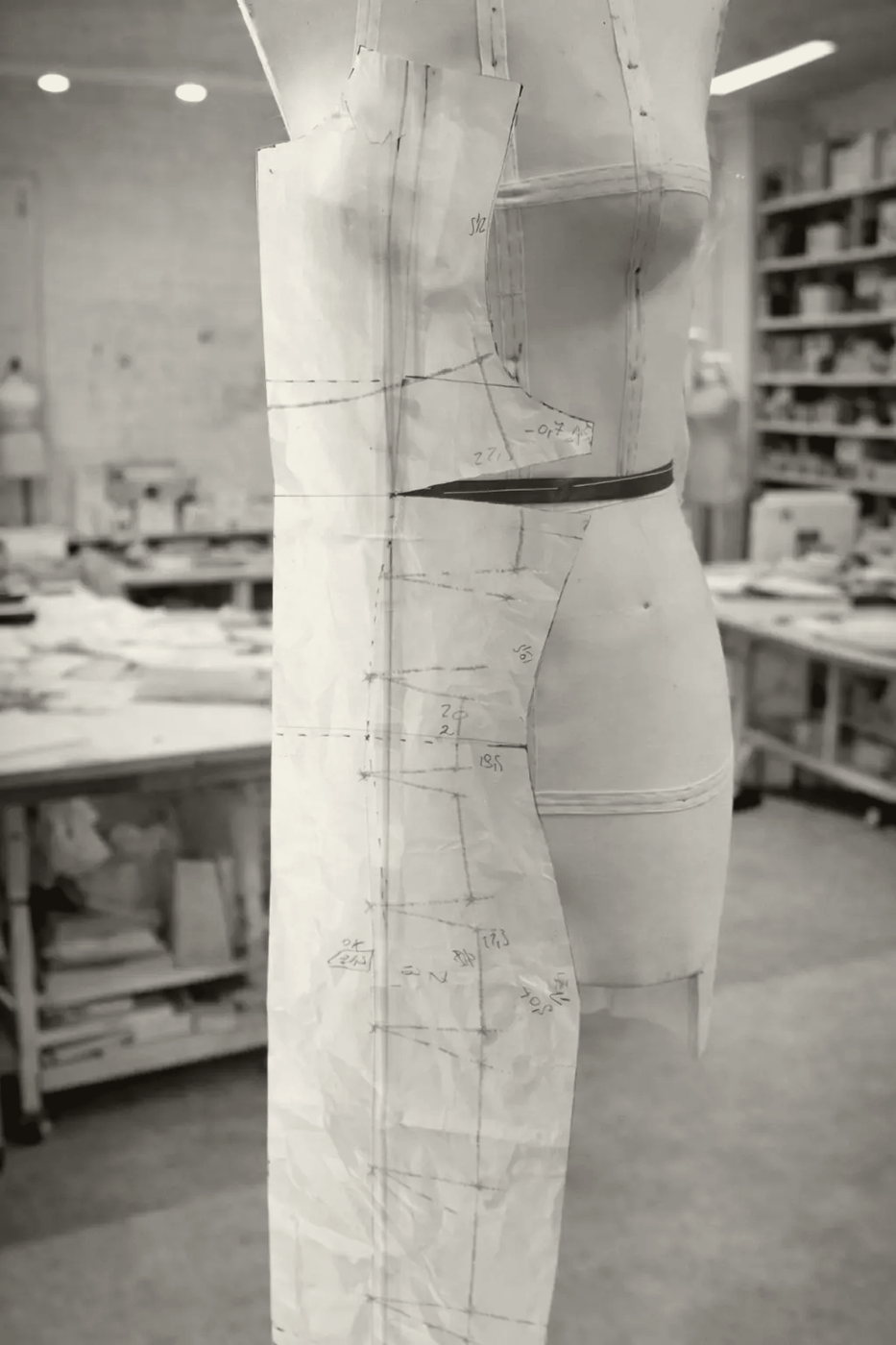
At Giardina Atelier, our couture pattern maker sculpts each style by hand, in paper, directly on the form, using the heritage Alta Moda moulage method, then translates it into the flat pattern. Fit and line are decided on the body, by eye, before a single sample is cut. For structured swimwear, the same expertise we bring to corsetry and lingerie, from internal construction to panel engineering, gives support without visible effort.
The swimwear tech pack
A swimwear tech pack records every detail a sample maker needs: measurements, fabric and lining, elastic types and tension, stitch types suited to stretch, cups or support structures, hardware and finishes. Developed together with the pattern, every measurement in it reflects the paper exactly. Developed separately, it is a common source of failed samples, as we explain in Tech Pack vs Pattern.
Sampling: testing in the real world
A swimwear sample should be tried on a fit model in your sample size, and ideally tested in water. Photograph and film it front, side and back, wet and dry, and write down every observation. Most styles need one or two rounds of refinement before approval.
Production and finishing
Luxury swimwear production calls for experienced machinists, the right stretch stitches and careful quality control of every elastic and seam. Once the sample is approved, the pattern is graded across your size range, and production samples confirm the fit in every size before production begins.
Questions to ask a luxury swimwear manufacturer
- Who drafts the patterns, and how much swimwear have they made?
- How do you account for fabric stretch and wet fit?
- How are fittings handled, and how many rounds are typical?
- Who owns the patterns and the tech pack?
Begin with the pattern
Whether you are designing a single signature swimsuit or a full resort collection, fit in the water starts on the form. Our Technical Foundation gives you a hand-sculpted, hand-drafted Couture Pattern and a Couture Tech Pack for each style, developed together, made in English and owned entirely by you, ready for sampling with us or with any swimwear manufacturer in the world.