
It is one of the most common stories in fashion. A founder commissions a beautifully illustrated tech pack, sends it to a factory, waits weeks, and receives a sample that looks nothing like the vision. The seams twist. The waist sits in the wrong place. The fabric collapses where it should flow. The founder pays for a second sample, then a third.
The problem is almost never the factory. It is a misunderstanding about two documents that sound similar but do completely different jobs: the tech pack and the pattern.
What a tech pack is
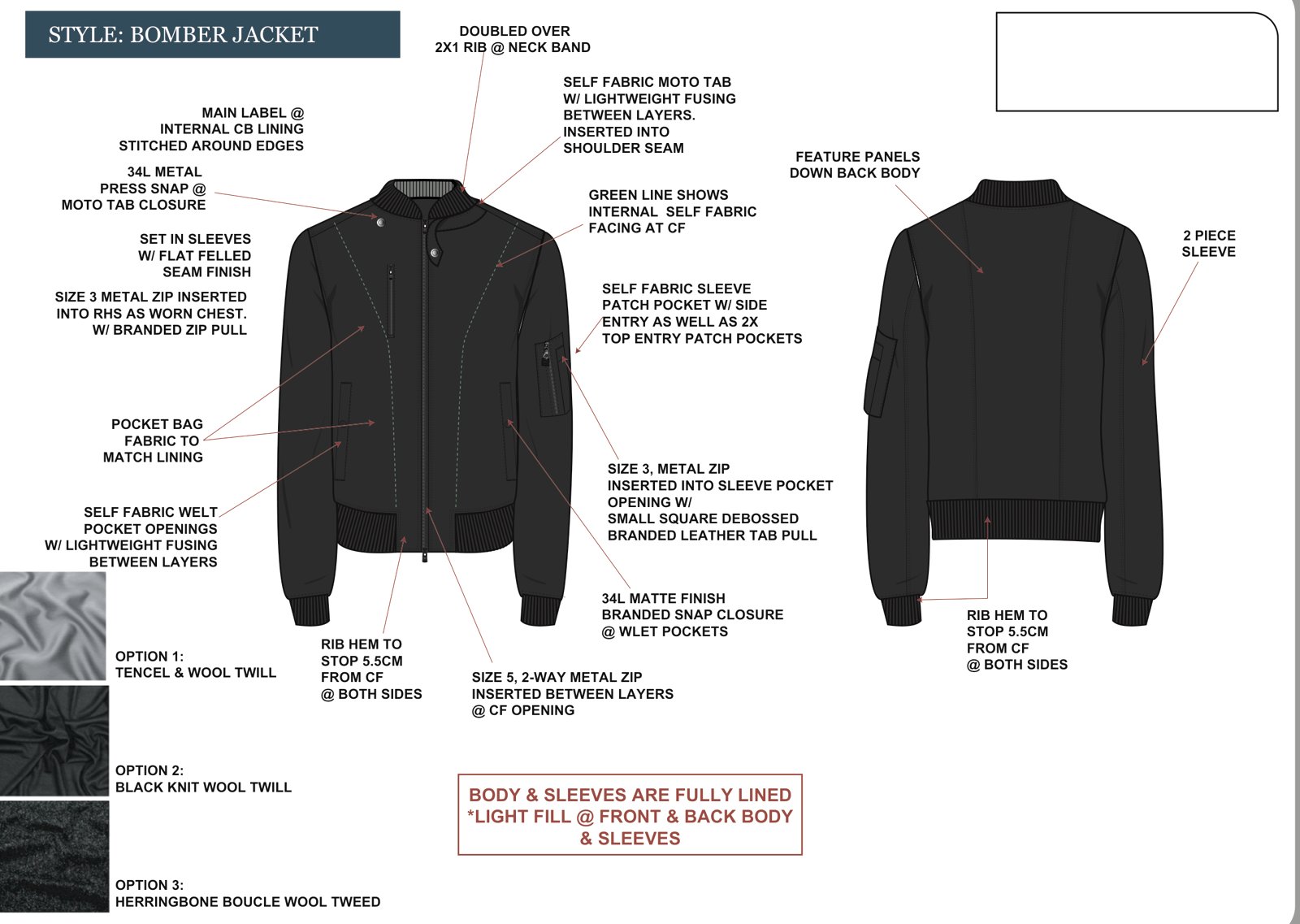
A fashion tech pack is the written blueprint of a garment. It describes what the garment should be: technical drawings, measurements, materials, trims, stitching, finishes and construction notes. It is how a brand communicates its intentions to everyone who will touch the garment.
A good tech pack is essential. But a tech pack is a description. It does not, on its own, tell anyone how to cut the cloth.
What a pattern is
A pattern is the garment’s engineering. It is the set of shapes, traditionally in paper, from which the fabric is cut. Every curve of the armhole, every dart, every seam angle is decided here. The pattern determines how a garment sits on the body, how it moves, and whether it holds its shape.
If the tech pack says what the garment is, the pattern decides how it becomes real.
Why the difference costs startups so much
When a factory receives only a tech pack, someone still has to make a pattern. Often it is drafted quickly, by someone who has never spoken to you, working from numbers rather than from the body. The measurements in your tech pack may even be contradictory, because they were chosen on a screen before anyone had seen the garment in three dimensions.
The result is a sample that matches your document but not your vision. Each correction means another round of sampling, another invoice and another few weeks. This is how founders spend thousands before they have a single garment they would sell.
In couture, the pattern comes first
The great houses work the other way round. In couture pattern making, the pattern maker sculpts the garment by hand, in paper, directly on the form. Fit, balance and proportion are decided on the body, by eye. Only then is the shape translated into a flat pattern.
This changes something fundamental: measurements are not predetermined, they are discovered. They emerge as the garment is sculpted, and only then are they written into the tech pack. The tech pack becomes a precise record of a garment that already works, rather than a hopeful description of one that might.
Why they must be developed together
A tech pack and a pattern made separately, by different people, will always disagree somewhere. Developed together, by the same couture pattern maker, they reflect each other exactly. Every measurement, construction detail and finish in the document corresponds to the paper.
That is why we never treat them as separate products in spirit, even though we offer them separately. Together they form the Technical Foundation.
Already have a tech pack?
Many founders arrive with one. It is a valuable reference, and our pattern maker will use it. But in couture, the pattern decides the measurements, so your existing tech pack serves as a guide rather than a rulebook. Developing the Couture Tech Pack alongside your Couture Pattern means you end up with a document that matches the garment exactly, complete with couture-level sewing notes most tech packs never include.
The short answer
- A tech pack tells a manufacturer what to make.
- A pattern decides how it will fit.
- Together, made by the same hand, they are what allow your first sample to look like your vision.
If you are about to approach a manufacturer, start with both. Discover the Technical Foundation.