There is a particular moment that almost every first-time fashion founder encounters, and it is often the moment when their understanding of product development is tested for the first time. The initial prototype arrives, carrying with it months of anticipation, creative attachment, financial investment, and the expectation that the idea imagined on paper will now appear fully resolved in three dimensions. The garment is unwrapped, placed on a dress form or fit model, studied from every angle, and almost immediately the founder begins to see what is not yet complete: the shoulder may require greater balance, the neckline may need more support, the waist may sit slightly too low, the sleeve may not fall with sufficient precision, the volume may feel too generous or too restrained, or the fabric may behave in a way that was impossible to predict from a sketch alone.
For a founder who has never worked inside the fashion industry, this can feel alarming. For an experienced designer, couture pattern maker, sample maker, or luxury atelier, it is entirely normal. The first prototype is not the final product, nor should it be treated as one. It is the first physical stage of an iterative process whose purpose is to transform a two-dimensional concept into a technically sound, aesthetically resolved, production-ready garment. The prototype is not evidence that development has failed. It is evidence that development has begun.
One of the most persistent misconceptions among emerging fashion brands is the belief that product development follows a clean, predictable sequence in which each stage is completed once and never revisited. The founder imagines that the tech pack is created, the pattern is drafted, the prototype is sewn, the sample is approved, and production begins. This model may appear logical on a spreadsheet, but it does not reflect the reality of serious fashion development, particularly at the luxury level. The path from concept to final sample is not linear. It is circuitous, responsive, and deeply creative. Each stage produces new information, and that information must be interpreted, tested, and incorporated into the next version of the garment.
At Giardina Atelier, we consider this iterative process one of the defining characteristics of true Made in Italy luxury fashion development. A garment of quality is not simply cut and sewn. It is observed, questioned, engineered, refined, and resolved. The difference between a mass-market product and a luxury product is rarely found in one dramatic design decision. More often, it is found in a succession of precise technical choices made throughout development, each one improving the fit, proportion, construction, movement, balance, and overall integrity of the garment.
The Technical Foundation Comes First
The process begins with the technical foundation. Before a pattern can be drafted intelligently, the design must be translated into a professional couture tech pack capable of communicating the logic of the garment. A strong tech pack is not merely a collection of flat sketches, measurements, and basic annotations. It is the technical language through which the designer’s vision is conveyed to the pattern maker and sample room. It should define the silhouette, construction lines, seam placement, internal structure, closures, finishes, proportions, fabric requirements, design details, and manufacturing expectations with enough clarity that the pattern maker can begin solving the garment before fabric is ever cut.
This stage is often underestimated because it is less visually exciting than the finished sample, yet it is one of the most consequential investments a fashion brand can make. Weak technical documentation creates ambiguity, and ambiguity creates unnecessary revisions. When critical decisions have not been resolved at the tech pack stage, the pattern maker is forced to interpret, assume, or improvise, which often results in additional sample rounds that could have been prevented. A strong couture tech pack, by contrast, establishes a disciplined technical framework from the beginning and allows the development process to advance with far greater accuracy.
The Pattern Maker as Engineer
Once the technical direction is established, the pattern maker begins the work of translating the design into three dimensions. For complex garments, couture pattern making is less comparable to drawing and more comparable to engineering. The pattern maker must understand how the fabric will move, how the garment will balance on the body, how the grain line will influence drape, how the internal construction will support the silhouette, how the seams will shape volume, and how each pattern piece will interact with the others once assembled.
The objective is not simply to produce shapes that can be sewn together. The objective is to create the hidden architecture required to realise the designer’s vision. A sculptural evening gown, a corseted dress, a tailored jacket, a highly fitted bodice, or an asymmetrical draped garment cannot be approached as a basic sewing exercise. These designs require technical intelligence, spatial understanding, construction knowledge, and the ability to anticipate how a visual concept will behave once it encounters the human body, movement, gravity, and fabric.
This is why the pattern maker is one of the most important figures in luxury fashion development. For technically demanding garments, the pattern maker operates much like a structural engineer. The designer may conceive the form, the proportion, the emotion, and the visual impact, but the pattern maker must determine how that vision can be supported and constructed in reality. Every seam influences balance. Every dart controls volume. Every curve affects fit. Every internal layer alters the way the garment sits and moves. Even a change of a few millimetres can significantly affect the final silhouette.
What the Prototype Is For
After the first pattern has been created, the project moves into prototype development. The prototype exists to test the translation between paper and reality. It is the first opportunity to evaluate whether the technical decisions made during the tech pack and pattern-making stages are producing the intended result once the garment is assembled in three dimensions. It allows the atelier to assess proportion, silhouette, balance, movement, fit, volume, construction logic, seam placement, and the relationship between the design and the body.
Depending on the nature of the project, the prototype may be made in the final fabric or in a development fabric chosen to simulate the weight, structure, stretch, and behaviour of the intended material. Whenever practical, developing in the final fabric offers the most accurate understanding of how the garment will perform, because no two textiles behave in exactly the same way. However, when the final material is exceptionally expensive, rare, custom-produced, or limited in availability, it may be more responsible to begin in an appropriate substitute.
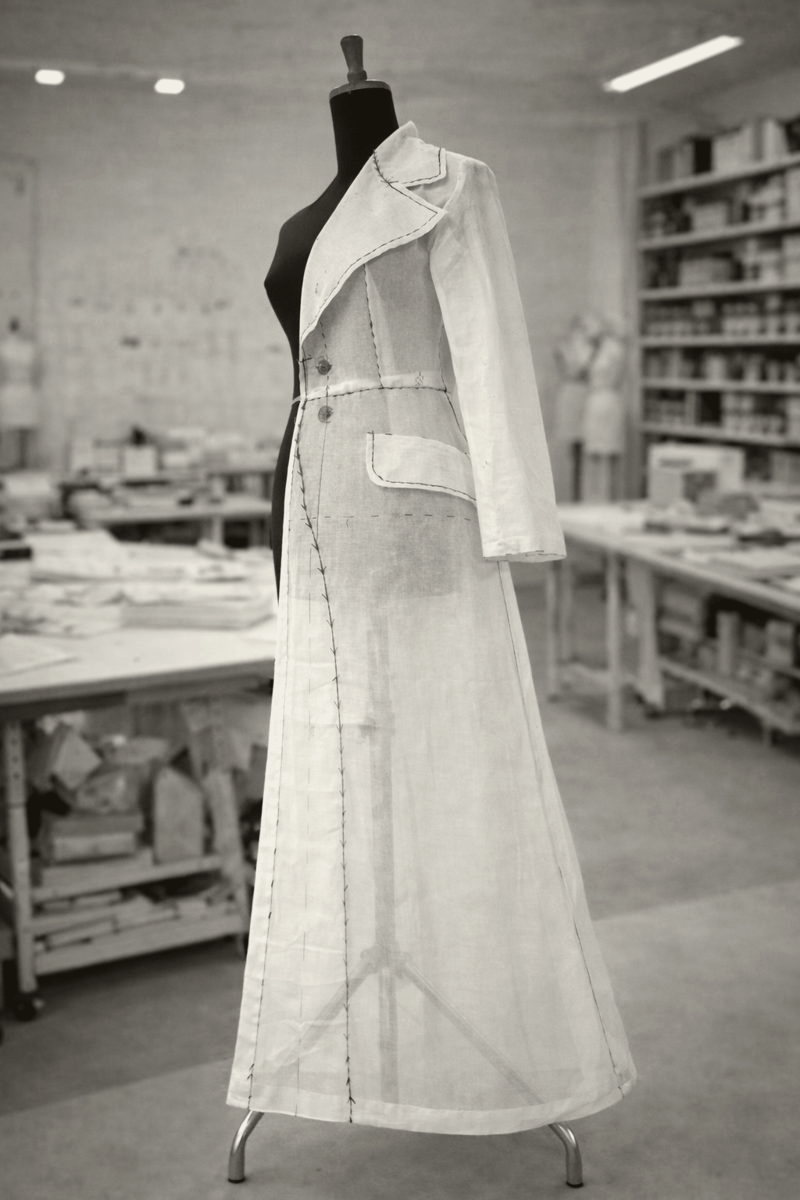
In Italy, this early development garment is often referred to as a tela; in French couture, it is known as a toile. It may not include every final finish, lining, embellishment, or luxury detail, but it should communicate the essential structure of the design accurately enough for the development team to evaluate the garment’s silhouette, proportion, shape, balance, and construction. The tela is not intended to impress the customer as a finished object. Its value lies in the information it reveals.
Once the prototype is placed on the body, the garment begins to communicate. A shoulder may need to rotate slightly forward. A sleeve pitch may require adjustment. The neckline may need more tension. A waist seam may need to rise. A panel may need to narrow. A drape may require redistribution. A grain line may need to shift. A hidden support may need to be introduced. These refinements do not indicate poor workmanship. They are the natural result of moving an original design from two dimensions into three.
No matter how talented the designer or experienced the pattern maker, it is impossible to predict every interaction between fabric, body, balance, gravity, movement, proportion, and construction before the garment exists physically. The purpose of the prototype is to expose those interactions while there is still time to respond intelligently. It provides evidence. It turns assumptions into observable results. It allows the pattern maker to revise the pattern with greater precision because the next decision is now based on the behaviour of the actual garment rather than theory alone.
Revision Is Not an Error
This is the point at which many inexperienced founders mistakenly believe that a revision means someone has made an error. In reality, revision is one of the essential tools of product development. The prototype informs the pattern, the revised pattern informs the first sample, and the first sample reveals the next layer of refinement. Each iteration should move the garment closer to the desired result, and each round should become increasingly precise.
A strong technical foundation does not eliminate iteration, because no serious product-development process can eliminate the need to test, evaluate, and refine. What it does eliminate is unnecessary iteration. When the project begins with a comprehensive couture tech pack and an experienced pattern maker, the first pattern is far more likely to establish the correct construction logic, fit direction, balance, and proportion. This means that subsequent rounds can focus on finesse rather than repair.
That distinction is critical. A weak development process spends sample rounds solving problems that should have been addressed before cutting began. A strong development process spends sample rounds elevating the product. Instead of correcting inaccurate dimensions, unclear construction, unstable seams, or poor pattern balance, the atelier can focus on the more sophisticated decisions that create luxury: refining the line of a shoulder, improving the fall of a sleeve, perfecting the shape of a neckline, softening a transition, adjusting the distribution of volume, or improving the relationship between the garment and the body.
At Giardina Atelier, this is why we insist on beginning with the highest possible level of technical development. Our couture tech packs and Made in Italy pattern-making process are not administrative preliminaries. They are the foundation upon which every successful prototype, sample, and production run depends. A strong pattern maker can significantly reduce the number of unnecessary development rounds because the structural questions are addressed correctly from the beginning. The client may still choose to refine the product further, but those later decisions are increasingly aesthetic, strategic, and intentional.
How Many Sample Rounds Does a Garment Need?
Certain garments will naturally require more development than others. A simple knit top may be resolved relatively quickly, while a structured corset, architectural evening gown, tailored coat, sculptural jacket, or highly draped dress may require multiple prototype and sample rounds. A design created for a specific or non-standard body type may introduce additional fitting considerations. An unusual fabric may react differently from what was expected. A dramatic silhouette may require hidden internal engineering. A design detail that appears effortless in an illustration may prove technically complex when translated into fabric.
The question is not whether the development process can be forced into a fixed number of rounds. The question is what the garment requires in order to become successful. Many projects can move from the initial prototype into one or two sample rounds before reaching approval, particularly when the technical foundation is strong and the design is relatively resolved. Other garments may require three, four, five, or more iterations. We look at why that time belongs to the product in Why Luxury Fashion Development Cannot Be Rushed.
The more ambitious the design, the more important it becomes to allow the design itself to lead the process. This does not mean abandoning budgets, timelines, or commercial judgment. Every brand must develop responsibly. However, forcing an unresolved garment into production to avoid another development round is rarely a saving. It simply transfers the cost of the problem into a later and more dangerous stage. Poor fit, unstable construction, disappointing fabric performance, and unresolved proportions become exponentially more expensive once multiplied across a production order.
Development is where questions are supposed to be discovered and answered. Production is where those answers should already be established.
Every Serious Creative Industry Iterates
This principle extends far beyond fashion. An architect does not design a complex building and move directly into construction without technical studies, revisions, models, and engineering review. A car manufacturer does not build one vehicle and immediately release it to the market. A graphic designer does not usually produce one logo concept and assume that it will require no further development. Software is tested through multiple versions before release. Every serious creative industry recognises that the first expression of an idea is rarely the final one.
Fashion product development should be understood with the same maturity. The first prototype is not a purchase delivered through an Amazon-style transaction. It is not the end of a one-click process. It is a working version of an original product that has never existed before. Its purpose is to reveal what must happen next.
Where Luxury Is Decided
The distinction between mass-market manufacturing and luxury fashion development lies partly in the willingness to respond to those revelations. A low-cost system may accept a garment as soon as it is technically sewable and commercially adequate. A luxury atelier asks a different set of questions. Is the proportion correct? Is the movement elegant? Is the construction worthy of the fabric? Does the garment feel resolved? Does the silhouette express the designer’s intention? Is there a better way to finish the interior? Can the shoulder, sleeve, neckline, drape, or balance be improved?
The pursuit of those answers is not inefficiency. It is craftsmanship.
True luxury is created through accumulation: one refined seam, one adjusted curve, one improved proportion, one cleaner internal finish, one more intelligent construction decision at a time. Many of these choices will never be visible to the final customer in isolation, yet together they create the unmistakable feeling of a well-developed product. The wearer may not know why the garment feels superior. They will simply know that it does.
This is also why the most highly skilled artisans often identify more opportunities for refinement rather than fewer. Expertise produces discernment. An experienced pattern maker sees imbalances that others miss. A skilled sample maker recognises when a construction method can be improved. A luxury development team understands that a garment can be technically complete and still not be aesthetically resolved. The role of the atelier is not merely to execute instructions, but to bring technical judgment to the process.
The First Version Is Not the Final Answer
For emerging brands, the most important mindset shift is to stop judging the first prototype as though it were the final product. It should be evaluated according to what it reveals, how clearly it expresses the intended direction, and what it teaches the development team. The first prototype informs the next pattern. The next pattern creates a stronger sample. The stronger sample allows the final refinements to become more specific. The process narrows until the technical construction, fit, silhouette, movement, fabric, finishing, and design language work together with confidence.
Since Giardina Atelier was founded in 2019, we have never considered the first prototype to be the destination. Nor should any serious luxury brand. The objective is not to produce an instantly perfect first version. The objective is to create the strongest possible technical pathway through which the garment can become exceptional.
With a precise couture tech pack, an experienced Italian pattern maker, skilled prototype and sample development, appropriate material testing, and a disciplined approach to refinement, a brand can avoid unnecessary sample rounds while preserving the iterations that genuinely improve the product. This is the balance that intelligent fashion development requires: not endless revision for its own sake, but purposeful iteration guided by expertise.
At Giardina Atelier, this is the standard we believe luxury brands should expect from their development partners. We do not treat pattern making, prototyping, and sampling as isolated services. We treat them as an integrated technical and creative process whose sole objective is to realise the designer’s vision in its most complete form.
Because luxury is not created by rushing from sketch to production. It is created by building the right foundation, asking the right questions, and refusing to confuse the first version with the final answer.