There is a persistent misunderstanding about how an original luxury product comes into being. A design is drawn, the thinking goes; its measurements are entered into a document, its pattern is completed, its materials are selected, and the atelier simply cuts and sews. The path from image to object appears orderly, predetermined, reassuringly linear.
True couture is something else entirely.
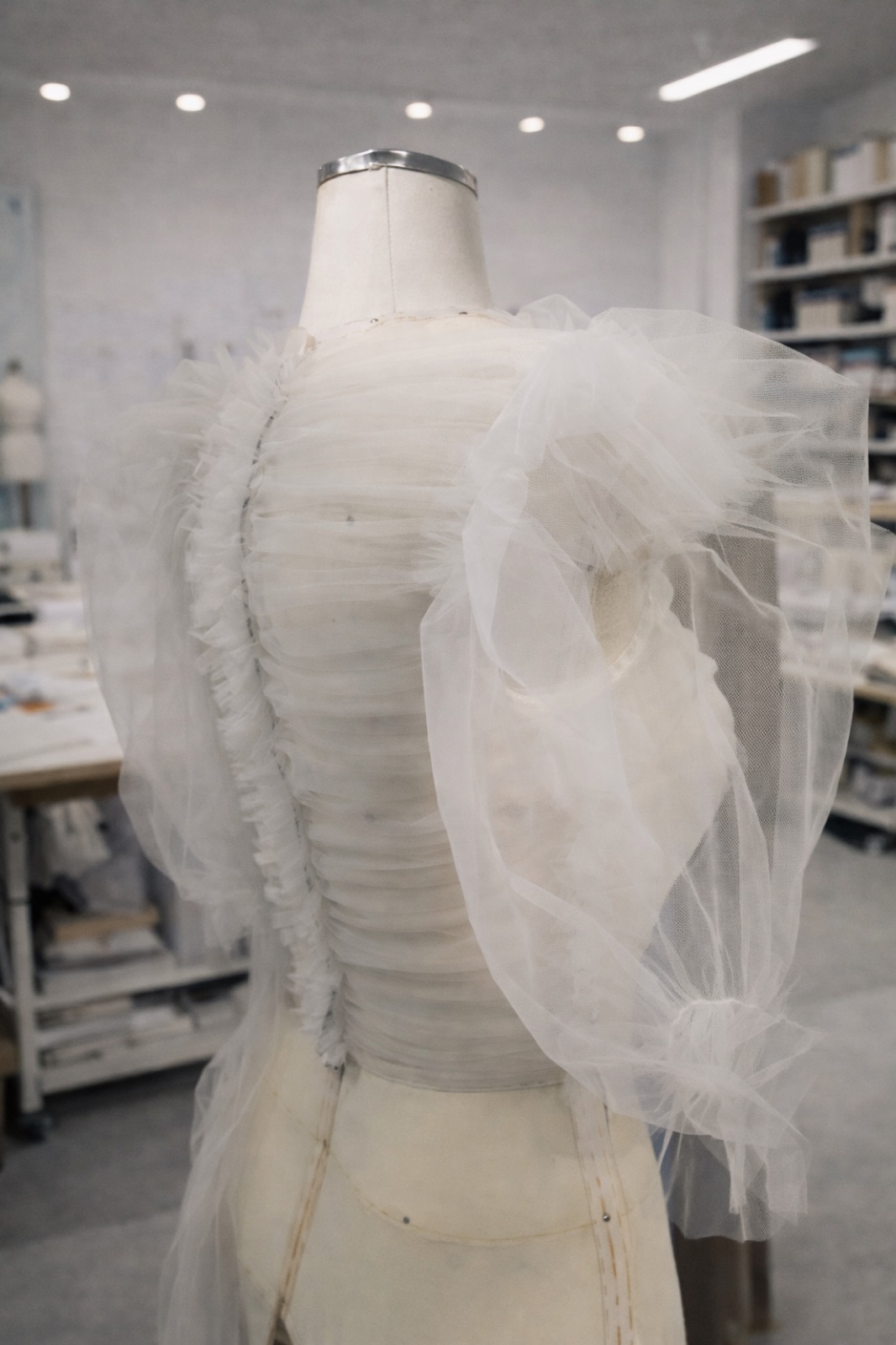
In the Italian Alta Moda tradition, an original design is not merely manufactured from a fixed set of instructions. It is discovered — through an intimate, highly technical conversation between the sketch, the hand, the material, and the three-dimensional form.
The patternmaker proposes a line. The samplemaker gives it volume. A fabric resists, collapses, or reveals an unexpected grace. An embroidery changes the balance of a surface. A proportion that appeared perfect on paper asks to be reconsidered once it exists in space. Each discipline informs the next, and often sends it back — more precise, more resolved, more beautiful — to the one before.
This is not uncertainty. It is expertise in motion.
For founders entering luxury development for the first time, the process can feel unfamiliar. Contemporary business culture has trained us to expect every variable to be known before work begins: final measurements, final pattern pieces, exact material consumption, complete embellishment placement, a fixed sequence of execution. Such systems have their place — in repeat production, once a product has already been developed and all of its answers are known.
Couture development begins earlier. At the far more rarefied moment when those answers do not yet exist.
The distinction is contained in the word itself: development. When a design has never before existed as a finished physical object, it must be physically developed before its final technical truth can be documented.
First, the Foundation
Every extraordinary silhouette begins with an underlying order. Depending on the design, the atelier may establish this through a toile or muslin prototype, a canvas, a master pattern, or an initial drape on the form. At this stage, the concern is not yet every finishing detail — it is the architecture: scale, proportion, balance, volume, and the relationship of one line to another.
The toile is sometimes mistaken for a lesser version of the finished object. In fact, its restraint is precisely its value. Freed from the seduction of the final fabric and embellishment, it allows both atelier and client to see the structure clearly. Is the shoulder in the correct position? Does the waist sit where the design demands? Is the sweep of a skirt generous enough? Does the object possess the intended scale and character?
Once this base is approved, it becomes the foundation upon which the individual design is developed. The client’s role at this milestone is both meaningful and specific: to review what has actually been presented — the proportions, volume, and overall form — and to approve or adjust that foundation before the atelier proceeds.
This clarity of milestones matters. Couture offers the client creative authorship and considered review; it does not require the client to direct the internal technical sequence of the artisans. The result is collaborative, while the methodology remains led by the specialists whose experience makes that result possible.
Moulage: Thinking in Three Dimensions
At the heart of the process is moulage — the practice of developing a design directly in three dimensions, on the dress form or physical base. It is often translated simply as “draping,” but the word hardly captures its intelligence. Moulage is at once a method of construction, a form of drawing in space, and a way of listening to material.
Here, line is not abstract. It has gravity. Volume casts a shadow. A seam can sharpen a silhouette or interrupt it. A millimetre can alter the attitude of a neckline; a subtle redistribution of fullness can transform how a garment moves. The artisan pins, releases, marks, cuts, rebalances, and observes. Decisions are made not in isolation, but in relation to the whole.
A finalized individual pattern cannot always precede the physical sample. The pattern is not merely an instruction imposed upon the design from the outside — it is also a record of what the atelier learns while resolving the design in three dimensions.
The process moves in both directions: from paper to form, and from form back to paper. An initial pattern creates the volume; the volume reveals what must change; the resolved moulage is then transferred back into the paper pattern. The final pattern becomes precise because it records a design that has been tested, corrected, and perfected in physical reality.
In other words: couture often begins in 3D and concludes by translating the resolved result into an authoritative 2D pattern.
A Constellation of Crafts
The romantic image of couture tends to focus on a single hand at work. In reality, an Alta Moda piece emerges from a constellation of highly specialized practices. Patternmaking, samplemaking, fitting, fabric development, internal construction, hand finishing, and embroidery do not sit in a neat line, waiting for the previous department to declare itself complete. They develop in parallel and continually inform one another.
A fabric may require a different internal support than anticipated. A sculpted detail may change the balance of a bodice. The weight of crystal embroidery may demand reinforcement or a subtle alteration to the underlying pattern. A beautifully drawn embellishment may need to shift by a fraction once it encounters the curve of the body. None of these discoveries represents a departure from the design — they are the means by which the design becomes possible.
The physical sample is therefore not a ceremonial rendering of decisions already made. It is an active technical instrument. It allows the atelier to test how the product behaves, how it is constructed, how it moves, and how each material interacts with the others. Through the sample, an idea acquires not only appearance, but integrity.
Embroidery Cannot Be Understood in Absentia
Nowhere is this more apparent than in hand embroidery and embellishment. A drawing can establish intention: rhythm, density, direction, colour, mood. But the final embroidery must be developed on — or in direct relationship to — the physical form.
An embroidery artisan evaluates the scale, weight, reflection, dimensionality, and interaction of each material. A bead that appears delicate in isolation may feel too heavy when repeated. A crystal may catch light exquisitely but disturb the fall of a fabric. The distance between motifs can change across a curve. Placement that looks balanced on a flat page may feel entirely different on the body.
The artisan must be allowed to work with these realities — to place, assess, refine, and sometimes replace. Only once the embroidery has been physically resolved does a final bill of materials truly exist. Before that point, documentation can describe the creative direction and intended technique, but it cannot honestly record every final component of an outcome that has not yet been created.
This is not an omission. It is the difference between documenting a hypothesis and documenting a perfected result.
Why the Tech Pack Evolves
A technical pack is indispensable, but its purpose changes across the life of a design. At the beginning, it communicates the creative and technical foundation: silhouette, construction intent, materials, finishing, measurements, and points requiring development. During sampling, some of that information is tested and refined. At the conclusion, the document is updated to reflect the approved physical sample — final measurements, resolved construction, confirmed embellishments, and the exact materials used.
For a genuinely new couture design, insisting that every final specification be immutable before the first physical development would confuse prediction with precision. Precision is achieved by testing the design, not by pretending the testing is unnecessary.
The same principle applies to digitization. Traditional Alta Moda pattern development is executed by hand — through paper, canvas, fabric, moulage, and samplemaking. A pattern still in development has no technical reason to be treated as final. Digitization, grading, and production engineering belong after the master pattern has been perfected against the approved sample — when the atelier is preserving a resolved result, rather than capturing an unfinished one.
The Luxury of Time — and Attention
Couture development is exacting, but it is not mechanically linear. Its timeline must make room for creation, evaluation, and refinement between the patternmaker, samplemaker, embroidery artisans, materials, and the object itself.
To a founder watching a launch calendar, a return to the pattern table may look like backward movement. Within the atelier, it is often the opposite: the work has revealed the next necessary act of precision. A revised proportion, a remade toile, or a new embellishment test is not time lost outside the process. It is the process — the visible evidence that the design is being considered rather than merely executed.
Luxury is frequently discussed in terms of rare materials and exceptional finishing. Its deeper privilege is attention — the freedom to notice what a standardized workflow would ignore, and the willingness to correct what an industrial timetable might accept.
The back and forth is not a sign that the atelier does not know where it is going. It is how an atelier of discernment refuses to settle for the first available answer.
A Typical Couture Development Rhythm
Although every design requires its own methodology, the rhythm often unfolds in this way:
- The creative and technical foundation is established
- An initial pattern and toile create the base form
- Proportions and volume are reviewed
- The first physical sample is developed in the intended or representative material
- Moulage, construction, and embellishment are refined together
- Discoveries from the sample return to the paper pattern
- The sample is reviewed at the appropriate milestone
- Further rounds are undertaken where necessary
- The approved result becomes the authority for the final pattern and technical documentation
- Only then is the design ready for digitization, grading, and production preparation, if those services are required
The arrows in this sequence do not all point forward. Couture advances through intelligent return.
Frequently Asked Questions
Why can’t the final pattern be completed before the sample is made?
Because the physical sample is one of the tools used to create the final pattern. The initial pattern establishes the form; moulage and sampling reveal how the design, material, and construction behave in three dimensions; and those discoveries are transferred back to the paper. The final pattern records the resolved sample, not merely the initial theory.
Does a revision mean that something has gone wrong?
No. Revision is intrinsic to original development. A new design must be tested in volume, material, and movement. Adjustments are how the atelier perfects proportion, construction, and finish. The absence of iteration does not necessarily indicate greater mastery — it may simply indicate that fewer questions were asked of the result.
Why can’t every bead, trim, and material be confirmed at the beginning?
The design direction can — and should — be established. Final selection and placement, however, may depend on scale, weight, curvature, fabric behaviour, and visual balance on the actual sample. Once the embellishment is physically developed and approved, its exact specification can be documented accurately.
When are the final tech packs updated?
Final technical documentation should reflect the final approved product. Measurements, construction details, material specifications, and the bill of materials are therefore confirmed or updated after the relevant physical development has resolved them. This prevents an early document from preserving information that the couture process has rightly refined.
Why isn’t the pattern digitized immediately?
Digitizing an unresolved pattern would merely create a digital version of work still in progress. The master paper pattern is first perfected against the approved physical sample. Digitization and grading are most useful later, during pre-production, when there is a final result worth preserving and scaling.
What is the client expected to approve?
The client reviews the creative result at clearly defined milestones: the foundational proportions, the physical sample, significant material or embellishment decisions where relevant, and the final resolved design. The atelier’s artisans lead the technical methodology — the sequence of patternmaking, moulage, construction, and refinement required to realize it.
Can an exact completion date be guaranteed for an entirely new couture design?
The atelier can provide a considered estimate and a milestone structure. But original Alta Moda development must also allow the product to reveal what it requires. A silhouette may resolve immediately; an intricate construction or embroidery may require further study. The goal is not indefinite experimentation, but sufficient time for the level of precision the commission demands.
Isn’t a more predetermined process more professional?
It is appropriate for a product that has already been developed and is ready for repeat production. It is not a substitute for developing an original couture piece. Professionalism in Alta Moda lies in knowing which decisions can be established in advance, which must be tested physically, and when the artisan has enough evidence to make a specification final.
The Final Object
At the end of the process, what once existed as an image has acquired an anatomy: a resolved pattern, tested proportions, an exact construction, materials chosen through use rather than assumption, embellishment placed in relationship to form, and technical documentation that describes what truly exists.
The beauty of couture is not that every answer was known at the beginning. It is that every answer was pursued with enough care to become inevitable.
At Giardina Atelier, this is the foundation of Italian Alta Moda development. We do not ask a design to conform prematurely to the limitations of a document. We allow it to be handled, observed, questioned, and refined by the artisans responsible for bringing it into the world. The result is not simply cut and sewn.
It is developed — by hand, in three dimensions, through knowledge, patience, and the rare luxury of attention.