
There is a moment in the creation of every garment when imagination must become instruction. A line drawn across a sketch must acquire an exact position. A fluid silhouette must be translated into proportion, balance and construction. Fabric must be told how to fall, seams where to meet and the atelier precisely what the designer intended. This is the purpose of the Technical Foundation.
The Hidden Cost of an Incomplete Foundation
Many emerging brands believe the first sample is where development begins. In reality, the most consequential decisions should be made before fabric is cut.
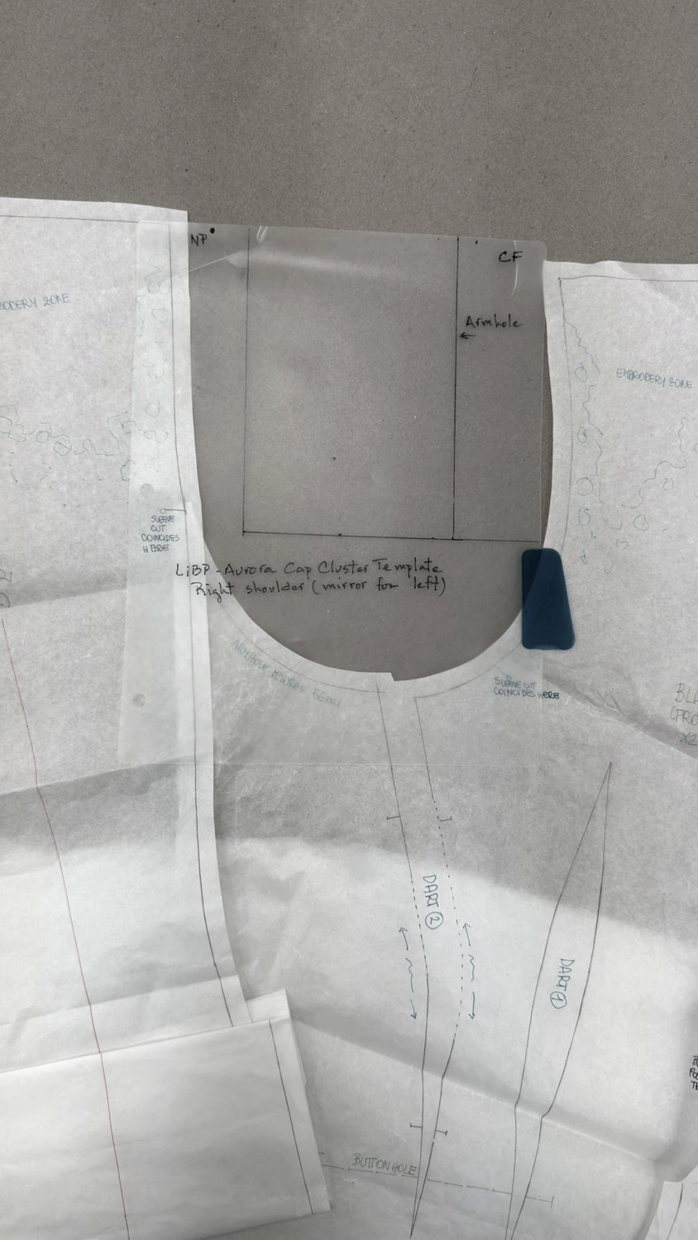
A sample room working from limited or contradictory information must fill in the missing details itself. It may interpret the neckline differently, choose an unsuitable construction, position a seam incorrectly or create proportions that depart from the original vision. The resulting sample can be beautifully sewn and still be fundamentally wrong.
The cost is not limited to remaking one garment. An unclear foundation can create:
- Additional sample rounds
- Repeated pattern corrections
- Wasted fabric and trims
- Conflicting quotations from manufacturers
- Delayed collection launches
- Inconsistent results between suppliers
- Production mistakes multiplied across an entire order
The first sample does not need to be final, particularly when developing an original or couture-led silhouette. Sampling is inherently iterative. But there is an important difference between a purposeful fitting adjustment and a preventable mistake caused by incomplete technical information.
A strong Technical Foundation cannot eliminate the creative refinement that belongs to the sampling process. It can eliminate much of the unnecessary confusion surrounding it.
What Is a Fashion Technical Foundation?
At Giardina Atelier, the Technical Foundation may include a Couture Tech Pack, a Couture Pattern, or both together as the complete Technical Foundation Package.
The Couture Tech Pack communicates the garment through technical drawings, construction information, materials, measurements and design specifications. It answers the questions a professional development partner should not be expected to guess.
The Couture Pattern translates the design into shape, proportion and volume. Developed through the discipline of couture patternmaking, it establishes how the garment will exist around the body, not simply how it appears on a page.
When used together, the tech pack and pattern perform different but complementary roles. One communicates the technical intention; the other gives that intention physical form.
Every Couture Pattern begins from a usable tech pack. A brand ordering Pattern only may provide its existing professional tech pack for review; otherwise, the two components can be commissioned together as the complete Technical Foundation.
Precision Before Production
Consider a seemingly simple slip dress. Its elegance may depend upon details invisible to the untrained eye: the angle of the neckline, the placement of the bust, the direction of the grain, the depth of the back, the relationship between ease and movement.
Without a considered pattern and clear technical instructions, the sample may hang incorrectly despite resembling the original sketch. Correcting it can require more than a minor alteration. It may require restructuring the pattern itself.
The same principle becomes even more important with tailoring, draping, lingerie, eveningwear and sculptural silhouettes. The more refined the design, the less room there is for vague interpretation. Technical development is therefore not an administrative stage. It is part of the design.
A More Intelligent Use of the Sample Room
A professional sample room should be refining a garment, not attempting to reverse-engineer the designer’s intentions from a mood board.
With a strong Technical Foundation, the conversation becomes more precise. Instead of asking what the garment is meant to be, the sample maker can concentrate on how successfully the first prototype expresses the established design.
Corrections can be evaluated against a defined technical reference. Decisions become easier to document. If the brand later changes manufacturing partners, the project does not need to be reconstructed from memory. The Technical Foundation becomes the permanent technical record of the style.
An Investment That Travels With the Brand
Factories and sample rooms may change. Collections may be produced in Italy, elsewhere in Europe or in another specialist manufacturing region. A properly developed technical foundation remains with the brand.
This independence is especially valuable for founders who are still deciding where to sample or manufacture. Separating the technical foundation from manufacturing gives the brand greater control and a clearer basis for comparing potential partners. The brand enters those conversations with defined assets rather than an undeveloped idea.
Begin With Clarity
Luxury is often associated with what is visible: the fabric, the finish, the final silhouette. But the quality of a garment begins much earlier, in decisions the customer will never see.
It begins with the line of the pattern. The logic of the construction. The precision of the instructions. The quiet architecture beneath the finished piece.
For brands preparing to enter sampling with a qualified atelier, sample room or manufacturing partner, the Technical Foundation establishes the clarity from which everything else can begin. Begin your Technical Foundation with Giardina Atelier.