Every garment begins as geometry. Before silk follows the body, before wool assumes the structure of a coat and before a dress appears to float without effort, there is a pattern determining its balance. Hidden inside the finished garment is a system of lines, curves and calculated volume that decides how the design will ultimately live. Not all patterns are created with the same ambition.
What Is a Standard Factory Pattern?
Factories are generally organized to manufacture efficiently. Their technical teams work within established construction methods, machinery, production targets and commercial tolerances.
When asked to develop a pattern, a factory may begin with an existing block and modify it according to the information provided. For a conventional T-shirt, sweatshirt or uncomplicated commercial silhouette, this can be an effective approach.
The challenge arises when the design depends upon subtleties that cannot be captured through standard measurements alone. A factory pattern may prioritize:
- Production efficiency
- Familiar construction methods
- Existing blocks
- Standardized proportions
- Compatibility with available machinery
- The factory’s interpretation of missing information
This does not make the pattern inherently poor. It means the pattern is frequently developed within the logic of the factory. A couture-level pattern begins within the logic of the design.
The Couture Approach
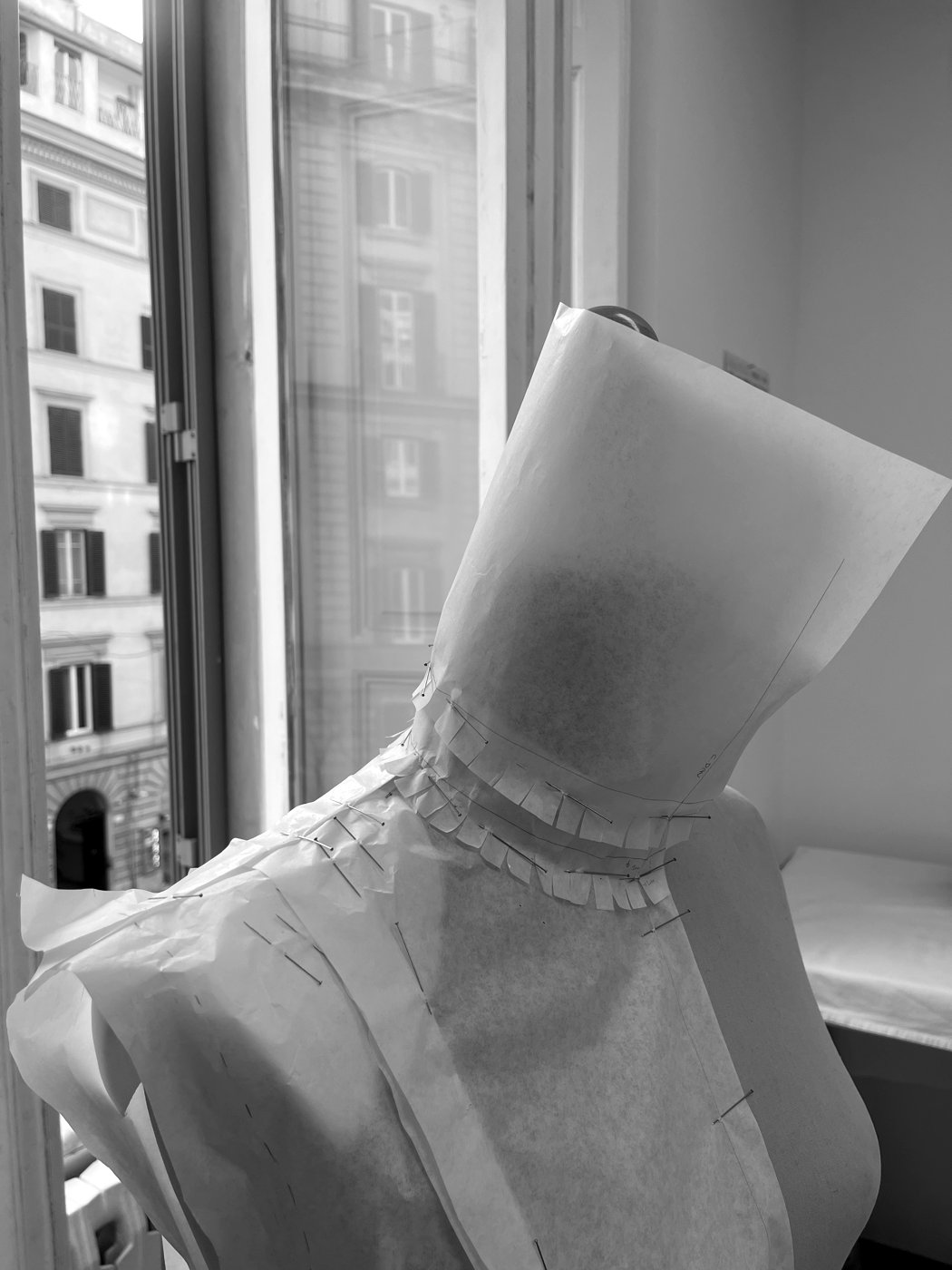
Couture patternmaking considers the body as a three-dimensional landscape. The patternmaker studies how the garment should relate to that landscape: where it should follow, where it should release, where it should create volume and where it should appear almost suspended.
One of the defining couture methods is moulage, the practice of developing form directly on the dress stand through draping. Rather than relying exclusively on a predetermined flat block, the patternmaker can observe the design spatially.
A line may look perfect in a drawing and still require adjustment when it travels around the body. A sculptural shoulder must be balanced against the neckline. A drape must be controlled without losing fluidity. A corseted form must create support without disturbing the external silhouette.
The pattern becomes an interpretation of the design, not merely a set of dimensions.
Where the Difference Becomes Visible
The distinction is most apparent in garments where proportion carries the entire design:
- Evening gowns
- Draped dresses
- Tailored jackets and coats
- Lingerie and corsetry
- Asymmetric silhouettes
- Sculptural tops
- Complex sleeves
- Bias-cut garments
- Designs developed from archival or visual references
In these garments, a difference of a few millimetres may alter the visual balance. The curve of an armhole affects the sleeve. The position of a dart changes the architecture of the bodice. The distribution of volume determines whether draping feels intentional or accidental.
A couture-level pattern addresses these relationships as a complete composition.
A Pattern Is Not a Tech Pack
The pattern and the tech pack are sometimes confused because both belong to technical development. They are nevertheless separate professional assets.
The tech pack communicates what must be made: the technical drawing, construction, materials, measurements and specifications. The pattern determines the shapes from which the garment will be cut.
A tech pack can describe the desired sleeve, but it does not replace the pattern pieces required to cut that sleeve. A pattern can create the shape, but it does not replace the broader construction instructions and technical documentation contained in the tech pack. For many original styles, the strongest foundation includes both.
Why Independent Pattern Development Matters
When a factory creates the only pattern, the brand can become technically dependent upon that factory. If the relationship changes, transferring the style elsewhere may be difficult, particularly when the original pattern or complete development records are not readily available.
A couture pattern commissioned independently from sampling and production gives the brand a defined technical asset that can be presented to qualified development and manufacturing partners. The pattern is developed from a usable tech pack, whether supplied by the brand or commissioned as part of the complete Technical Foundation.
A professional partner may still adapt seam allowances, production methods, sizing or technical conventions to suit its systems. What changes is the starting point: the original design has already been professionally resolved.
Couture as Infrastructure
Couture is often imagined as ornament: the embroidery, the hand finishing, the final hours of invisible work. But couture also exists in structure. It is present in the disciplined preparation beneath the surface.
A couture-level pattern is not valuable because it makes the development process magically free from fittings or refinement. It is valuable because it gives refinement a sophisticated beginning. It replaces approximation with intention.
Because the quality of a garment is decided long before the final stitch, the pattern is not simply behind the design. It is the design, translated into form.
Giardina Atelier develops Couture Patterns for brands seeking an elevated technical starting point for sampling and manufacturing, informed by Alta Moda tradition and the dimensional intelligence of moulage. Commission your Couture Pattern through Giardina Atelier.