
Before a garment becomes an image, an object of desire, or a piece worn out into the world, it begins somewhere quieter.
It begins with a line.
A line drawn by hand. A curve studied against the architecture of the body. A piece of paper cut, shaped, reconsidered, and refined until an idea that once existed only in the imagination begins to acquire dimension. This is the unseen beginning of fashion: the pattern.
At Giardina Atelier, we believe that beginning matters.
“The marvelous is always beautiful, anything marvelous is beautiful, in fact only the marvelous is beautiful.”— André Breton
Breton’s words express the very thesis of our work. The marvelous is not perfection emptied of feeling; it is the moment an object transcends its function and awakens wonder. In fashion, it appears when cloth becomes more than cloth—when line, proportion, movement, and the touch of the human hand combine to create something that feels alive. A garment may be useful, technically correct, and commercially viable. But when it carries artistry, intention, and soul, it becomes marvelous. And only then does it become truly beautiful.
The couture pattern is often described as a blueprint—and technically, it is. It determines proportion, balance, construction, movement, and fit. It translates a fashion designer’s creative vision into a language from which a garment can actually be made. But to call it only a blueprint is to miss its deeper significance. In the hands of an expert couture patternmaker, a pattern is not simply an instruction. It is an original work of art.
It is where precision and intuition meet.
This belief lies at the heart of the Giardina Atelier Technical Foundation: a professional Couture Tech Pack and handmade Couture Pattern Development created in Italy to give a fashion design its complete technical and physical language. For anyone preparing to launch a fashion brand, develop a capsule collection, or transform an original sketch into a production-ready design, this is where serious fashion product development begins. It provides the clarity a brand needs to sample, reproduce, and protect its vision. Yet its value reaches far beyond better fit, smoother development, or stronger commercial potential—important as each of those things may be.
Its truest value is that it places the human hand back at the center of creation.
A handmade couture pattern is not merely the map of a garment. It is the first physical expression of its soul.
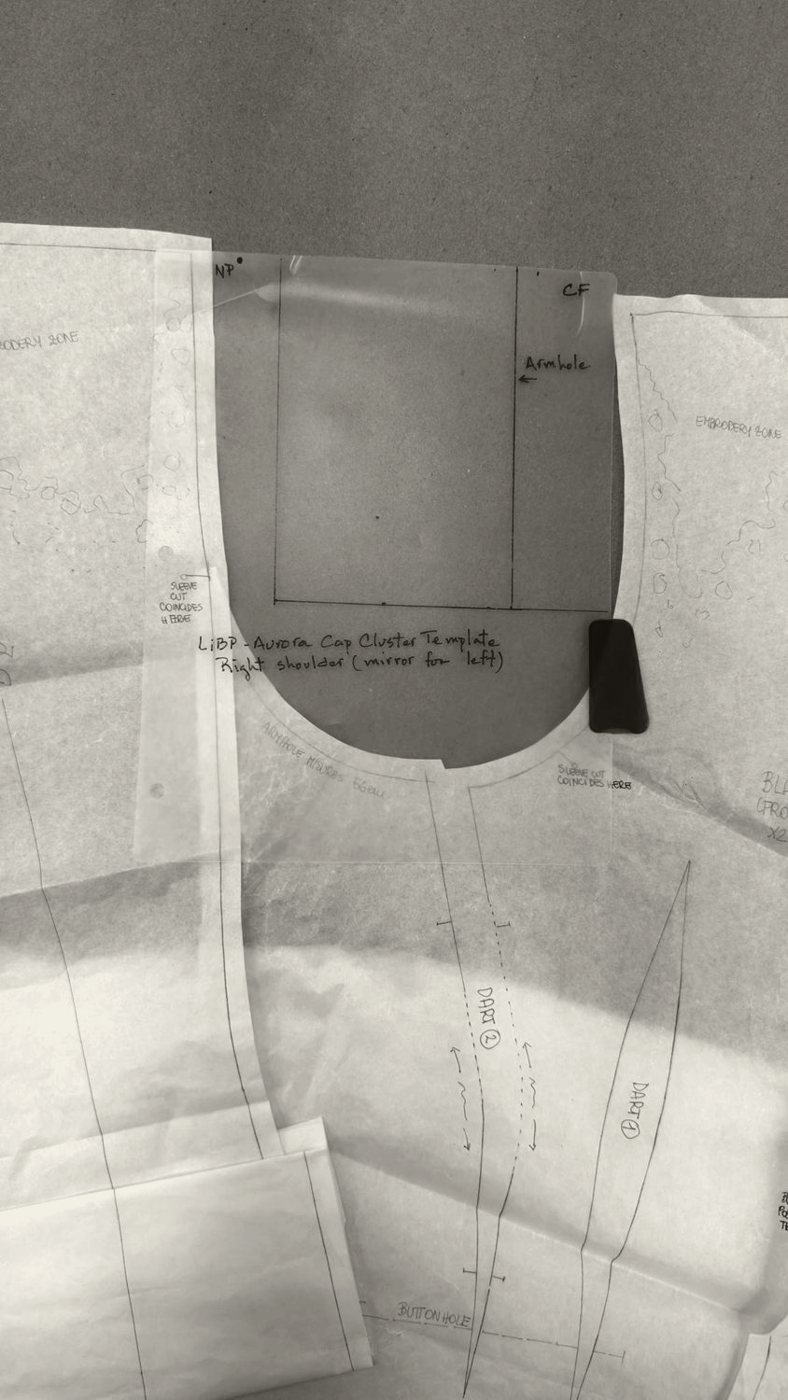
The Quiet Intelligence of the Hand
There is knowledge that cannot be reduced to software.
It lives in the eye of the maker: in the ability to sense when a line must soften, when a volume must be released, when a proportion is technically correct but artistically unresolved. It is found in the gesture of draping fabric against a form, in the dialogue between paper and body, and in the thousand nearly invisible decisions through which silhouette becomes presence.
This is couture patternmaking at its highest level. It is technical mastery guided by artistic instinct—the essence of Italian fashion craftsmanship.
A skilled clothing patternmaker does not merely record measurements. She interprets the designer’s intention. She considers how the body will inhabit the garment, how fabric will respond to gravity and motion, and how a silhouette should feel—not only when photographed, but when lived in. Through traditional moulage, hand-draping, and the sculpting of paper, she gives structure to an idea without extinguishing its emotion. This is custom pattern development shaped around the identity of the design, rather than forcing the design into a generic block.
The result looks different because it is different.
It carries evidence of attention. A curve has been seen, not generated. A proportion has been felt, not simply calculated. The garment has passed through a human consciousness before it reaches the human body.
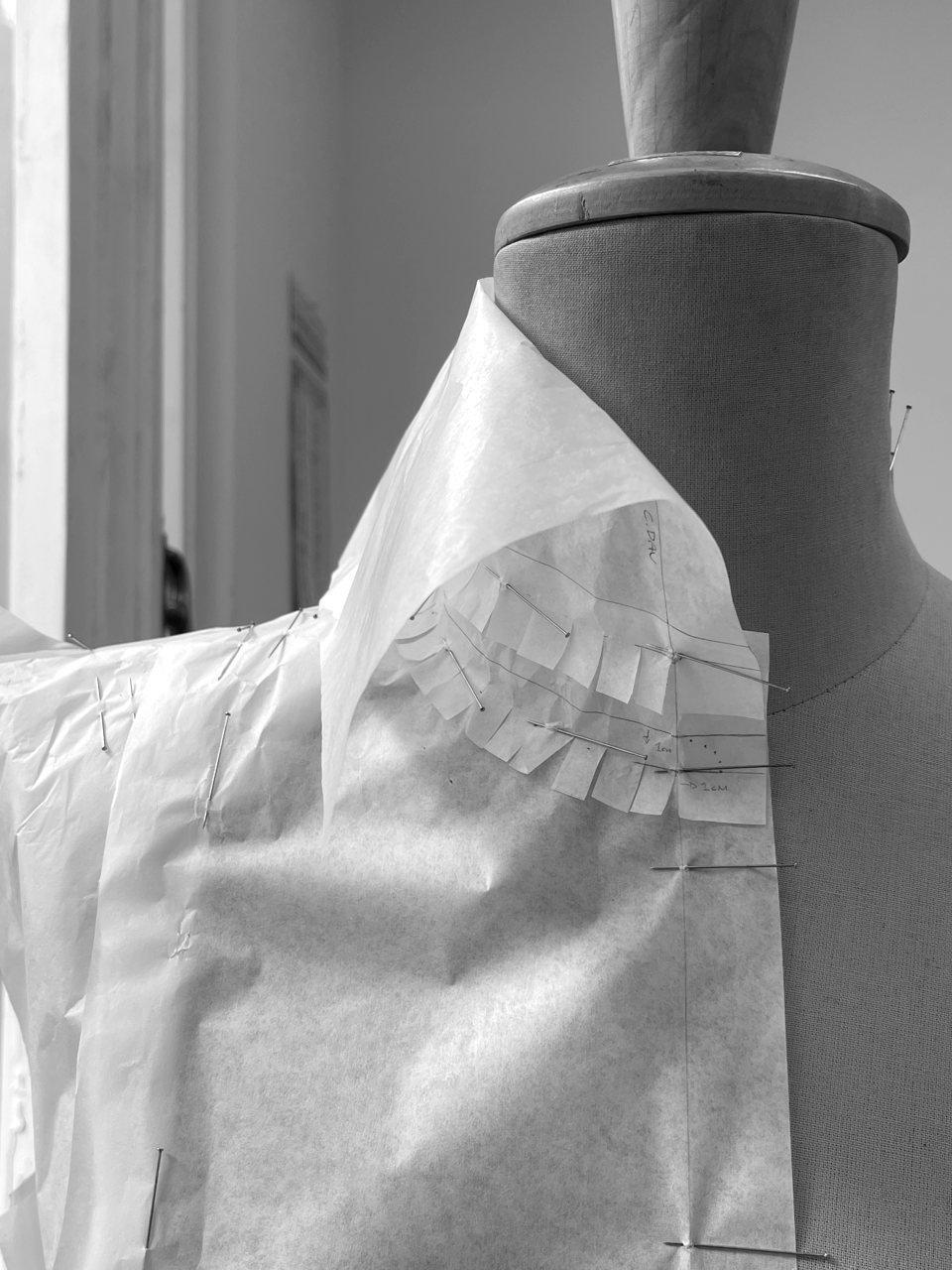
Fashion With an Aura
We recognize this quality instinctively in garments from another era. Pieces made fifty or a hundred years ago often possess a presence that is difficult to name. Even when the object itself is simple, it can feel alive. It bears the intelligence of its construction, the patience of its making, and the particular vision of those whose hands brought it into being.
It has an aura.
This is not nostalgia for the past, nor a rejection of technology. Digital tools can be extraordinary. Artificial intelligence can expand imagination, and digital patternmaking can produce beautiful results when guided by genuine expertise. The question is not whether technology belongs in fashion. The question is whether, in our pursuit of speed, we have allowed technology to replace the human discernment that once gave fashion its depth.
Too often, the modern garment is conceived for immediacy: made quickly, flattened into content, reproduced at scale, and forgotten almost as fast. Its construction is anonymous. Its proportions are generic. It may resemble fashion, but it does not always carry the inner life that transforms clothing into art.
A garment developed from a thoughtful couture pattern resists that emptiness. It contains intention from its very first line. Before the final fabric is cut, before a seam is sewn, before the piece ever meets the world, someone has already cared deeply about what it will become.
That care is perceptible. We see it. We feel it.
The Architecture of Feeling
Excellent garment fit is frequently discussed as a commercial advantage, and rightly so. A beautifully resolved fashion pattern can help a brand produce with greater consistency, reduce uncertainty during sample development, communicate more clearly with a clothing manufacturer, and create garments that customers want to return to. Together with a detailed Couture Tech Pack, it can become part of the intellectual and creative foundation on which an entire luxury fashion brand is built.
But fit is also intimate.
The way a garment meets the body can alter posture, movement, and perception. When clothing feels right—when it supports rather than restricts, follows rather than fights, and reveals rather than disguises—it changes the way a person enters a room. Comfort becomes confidence. Beauty becomes expansion.
To feel good in one’s body is not superficial. It is emotional, physical, and, at times, profoundly spiritual. We move through life differently when we feel at home in ourselves. We become more expressive, more receptive, more fully present. The right garment cannot create that wholeness for us, but it can honor it. It can become a vessel through which it is felt.
This is why the architecture beneath clothing matters. Patternmaking shapes not only the exterior form of a garment, but the private experience of the person inside it.
When a garment is made with attention, it gives attention back to the person who wears it.
An Act of Creative Rebellion
In the age of digital everything, preserving handmade craft is a quiet act of rebellion.
It is a refusal to accept that faster is always better, that sameness is efficiency, or that the only purpose of fashion is to generate another commodity. It is a declaration that the time of the artist still has value. That mastery still matters. That beauty deserves a foundation equal to its ambition.
For an emerging fashion designer or established independent label, this choice can be revolutionary. A brand does not need to imitate the machinery of mass fashion in order to succeed. It can begin from a different premise: that every style deserves intelligence, integrity, and its own distinct life.
The Giardina Atelier Technical Foundation was created to make that level of luxury fashion development accessible to brands at the moment it matters most—the beginning. Through a precise Couture Tech Pack and a handmade couture pattern developed by an expert eye, a fashion sketch is transformed into something tangible, ownable, and ready for prototype and sample development. It is a clear starting point for designers searching for couture patternmaking in Italy, Couture Tech Pack services, or expert technical development for a clothing brand.
Yes, this foundation supports future clothing production. Yes, it protects fit, proportion, construction, consistency, and the future of the design. Yes, it gives a fashion brand the technical confidence to grow—and provides professional documents and a physical couture pattern that belong to the client after payment.
But it also does something more beautiful: it ensures that growth begins with art.
Bringing More Art Back to the Planet
The Giardina Atelier manifesto is simple: to bring more art back onto the planet.
Not art as decoration. Not art as a marketing adjective. Real art—the kind shaped by knowledge, devotion, risk, discipline, and love.
Imagine a fashion landscape in which more brands began this way. Imagine fewer garments created without identity and more pieces formed through the eye and hand of a true maker. Imagine clothing with character, permanence, and emotional resonance: garments not merely consumed, but cherished.
This is abundance in its richest sense. It is commercial possibility joined with creative integrity. It is a successful brand producing something worthy of its success. It is a designer able to offer the world not simply another product, but a piece of lived artistry.
Fashion has always had the power to shape culture, to carry memory, and to change the way we experience ourselves. Its future need not be stripped of soul. Innovation and tradition can exist together. Technology can serve vision without replacing touch. Growth can be pursued without sacrificing reverence.
The revolution may begin more quietly than we expect—with paper, a pencil, a pair of shears, and the practiced hand of a couture patternmaker.
But from that first line, an entire world can emerge.
The Giardina Atelier Technical Foundation unites a professional Couture Tech Pack with handmade Couture Pattern Development in Italy, transforming a designer’s creative vision into a precise, ownable foundation for prototype development, future production, and the life of the brand.
Discover the Technical Foundation